Skip to content

What Is an Air Handling Unit (AHU)? Components, Working Principle, and Applications in HVAC Systems
Learn what an Air Handling Unit (AHU) is, its main components, working principle, air treatment functions, and its role in factories, hospitals, commercial buildings, and industrial facilities.
What Is an Air Handling Unit (AHU)?
An Air Handling Unit (AHU) is a centralized air treatment device used to condition and process air before distributing it to occupied spaces within a building. AHUs are commonly installed in medium- to large-scale commercial and industrial buildings, including office buildings, hospitals, airports, manufacturing facilities, and other large infrastructure projects.
Typical AHU installation locations include:
- Basement: AHUs are often installed in basements to serve lower floors or function as the central air handling system for part of the building.
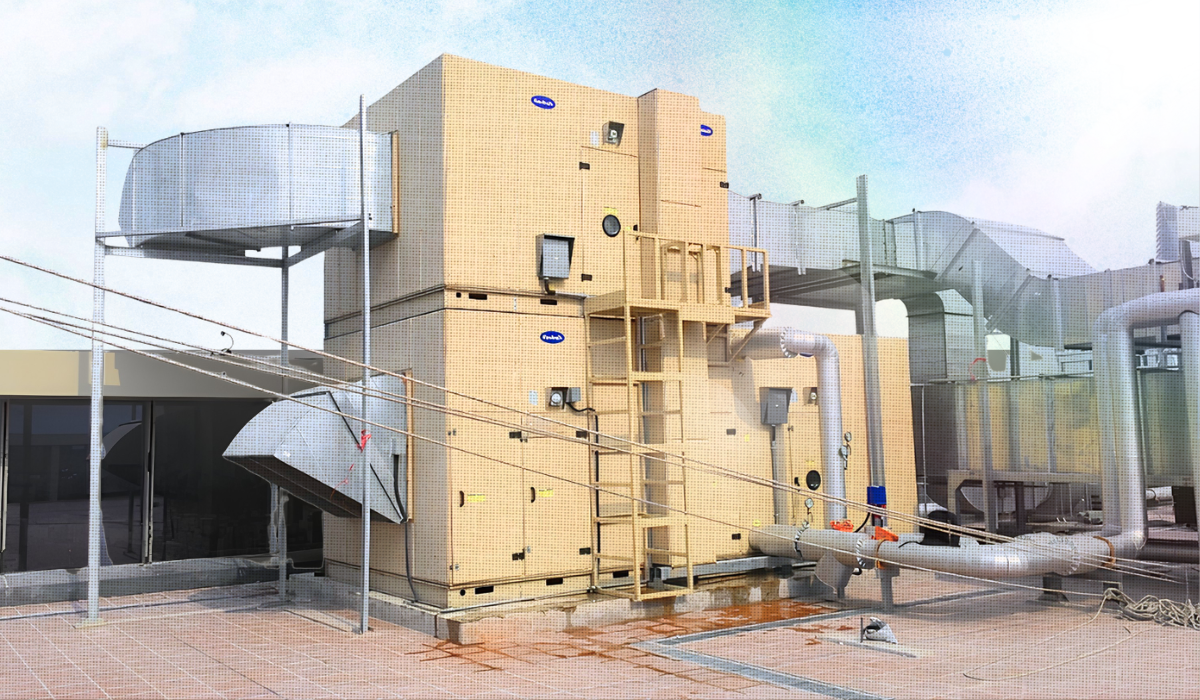
- Rooftop: This is one of the most common installation locations, particularly for air-cooled AHUs or large-capacity units serving an entire building. In many traditional high-rise buildings, a single large AHU located on the roof supplies conditioned air throughout the building.
- Individual building floors: Many modern buildings utilize multiple smaller AHUs installed on each floor or within specific zones, allowing better control of temperature and indoor air quality for individual areas.
- Dedicated mechanical rooms: AHUs may also be installed in plant rooms that house other HVAC equipment such as fans, filters, heating coils, and cooling coils.
Components of an AHU
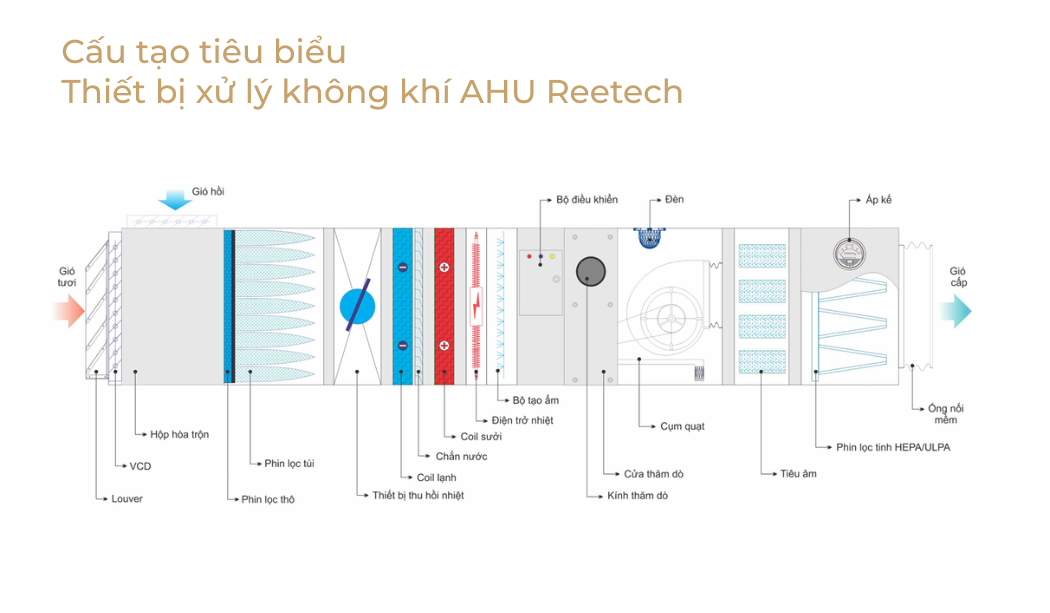
A typical Air Handling Unit consists of the following major components:
Casing and Frame
The casing and structural frame protect the internal components from external impacts while preventing foreign objects from entering the mechanical sections of the unit.
Fan
The fan draws fresh air or return air into the AHU and delivers the conditioned air through the ductwork system for distribution throughout the building.
Filter Section
The filtration section removes dust, allergens, and airborne contaminants from the airstream. AHUs typically incorporate multiple filtration stages, including:
- Pre-filters
- Fine filters
- High-efficiency filters such as HEPA or ULPA filters, depending on the application.
Coil Section
Cooling or heating coils use chilled water, hot water, or direct expansion (DX) refrigerant to cool or heat the air to the required supply air temperature.
Other Components
Depending on project requirements, an AHU may also include:
- Sound attenuators
- Heat recovery devices
- Electric or hot-water heaters
- Humidifiers
- Control systems
- Various accessories
Working principle of an AHU
An Air Handling Unit operates through a continuous air treatment process to maintain the required indoor environmental conditions.
- Air Intake: The fan draws outdoor fresh air and/or return air from occupied spaces into the AHU through the return air duct.
- Air Filtration: The incoming air passes through one or more filter stages to remove dust, particles, and other airborne contaminants.
- Temperature and Humidity Conditioning: The filtered air passes through the cooling or heating coils where its temperature is adjusted according to the system requirements. When humidity control is required, humidifiers add moisture to the air, while cooling coils remove excess moisture through condensation during the cooling process.
- Air Distribution: After being conditioned, the supply fan delivers the treated air into the supply plenum, from where it enters the ductwork system and is distributed to designated areas throughout the building.
- Energy Recovery: In modern AHUs, part of the thermal energy contained in the exhaust air can be recovered through energy recovery wheels or plate heat exchangers. This recovered energy is used to pre-cool or pre-heat the incoming outdoor air, significantly reducing HVAC energy consumption.
The combination of the AHU and the air distribution system.
The Air Handling Unit and the air distribution system work together to form a complete air circulation cycle within an HVAC system. In this process, the AHU acts as the “heart” that conditions and moves the air, while the ductwork serves as the “circulatory system” that transports air throughout the building.
This integrated process consists of three primary stages:
- Air Collection: Air from occupied spaces is drawn through return air grilles and conveyed back to the AHU via the return air duct system.
- Air Treatment: Inside the AHU, the return air and outdoor air are filtered, heated or cooled, and humidity is adjusted according to the thermostat and system control settings.
- Air Distribution: After conditioning, the supply fan generates the required pressure to deliver the treated air through the supply ductwork and into occupied spaces via supply air diffusers or grilles.
The Air Handling Unit is one of the most important pieces of equipment in an HVAC system, responsible for treating and conditioning air before it is distributed throughout a building. However, the overall performance of the HVAC system depends not only on the AHU itself but also on a properly designed, manufactured, and installed air distribution system.
The integration of these two components ensures stable temperature, humidity, and Indoor Air Quality (IAQ), while improving energy efficiency, reducing operating costs, and extending the service life of the entire HVAC system.
For facilities such as manufacturing plants, hospitals, shopping malls, airports, and office buildings, selecting the appropriate AHU and investing in a high-quality air distribution system are essential to meeting operational, safety, and long-term performance requirements. In addition, proper system design, installation, and preventive maintenance in accordance with applicable technical standards are critical to ensuring reliable HVAC performance throughout the building’s lifecycle.