Skip to content


What is the ASHRAE Standard?
What is the ASHRAE Standard? its role in HVAC system design, the most widely used ASHRAE standards, and why they are extensively adopted in modern building projects.
What is ASHRAE?
ASHRAE ( the American Society of Heating, Refrigerating and Air-Conditioning Engineers) is a global, non-profit technical organization dedicated to advancing the arts and sciences of heating, ventilation, air conditioning, refrigeration (HVAC&R), and building systems.
Founded in 1894, ASHRAE brings together tens of thousands of engineers, researchers, manufacturers, consultants, contractors, and building professionals worldwide.
Beyond developing technical standards, ASHRAE conducts research, promotes technological innovation, provides professional education, and publishes the renowned ASHRAE Handbook, one of the most authoritative references used by HVAC engineers around the world.
The Role of ASHRAE in HVAC Design
ASHRAE standards provide the technical foundation for designing, testing, operating, and maintaining HVAC systems. They help engineers develop systems that achieve:
- Comfortable indoor environments
- Good Indoor Air Quality (IAQ)
- High energy efficiency
- Operational safety
- Sustainable building performance
In general, ASHRAE publications can be categorized into three major groups:
- Test Methods
- Design Standards
- Standard Practices
Common ASHRAE Standards Used in HVAC Design
ASHRAE Standard 62.1 – Ventilation and Acceptable Indoor Air Quality
ASHRAE Standard 62.1 establishes the minimum ventilation requirements necessary to achieve acceptable indoor air quality (IAQ) in commercial and institutional buildings.
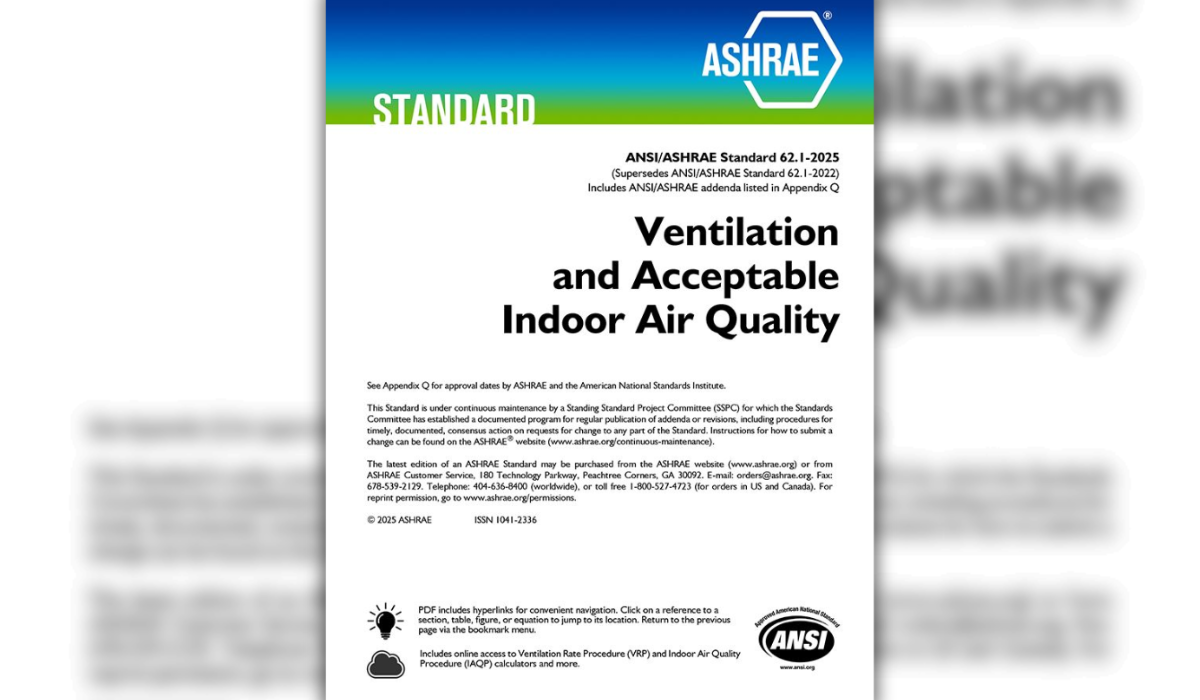
(*) According to ASHRAE Standard 62.1-2025, acceptable indoor air quality is defined as:
“Air in which there are no known contaminants at harmful concentrations as determined by cognizant authorities and with which a substantial majority (80% or more) of the people exposed do not express dissatisfaction.”
ASHRAE Standard 55 – Thermal Environmental Conditions for Human Occupancy
ASHRAE Standard 55 defines acceptable thermal comfort conditions for occupants inside buildings.
The standard considers multiple environmental and personal factors, including:
- Air temperature
- Mean radiant temperature
- Relative humidity
- Air speed
- Occupant activity level
- Clothing insulation
Its primary objective is to create thermal conditions acceptable to the majority of occupants while avoiding unnecessary energy consumption.
ASHRAE Standard 90.1 – Energy Standard for Buildings
ASHRAE Standard 90.1 establishes minimum energy efficiency requirements for commercial buildings and high-rise residential buildings.
The standard covers:
- HVAC equipment efficiency
- Building envelope insulation
- Lighting systems
- Electrical power systems
- Automatic controls
- Energy management strategies
ASHRAE 90.1 is one of the most frequently referenced standards in LEED-certified and other sustainable building projects, helping reduce operating costs while minimizing environmental impact.
ASHRAE Standard 15 – Safety Standard for Refrigeration Systems
ASHRAE Standard 15 specifies the minimum safety requirements for the design, construction, installation, and operation of refrigeration systems.
Its purpose is to protect:
- Human life
- Public health
- Property
- The environment
The standard applies to most stationary refrigeration systems, including:
- Residential air-conditioning systems
- VRF/VRV systems
- Commercial chilled-water systems
- Industrial refrigeration systems
However, it does not cover ammonia (R-717) refrigeration systems or small household appliances, which are governed by separate standards.
Major topics include:
- Refrigerant classification
- Refrigerant concentration limits
- Machinery room requirements
- Refrigerant piping
- Safety devices
- Equipment installation requirements
ASHRAE Standard 170 – Ventilation of Health Care Facilities
ASHRAE Standard 170 establishes HVAC requirements for hospitals and healthcare facilities.
The standard defines minimum environmental conditions to control airborne contaminants, reduce infection risks, and protect patients and healthcare personnel.
Key requirements include:
Air Changes per Hour (ACH)
Different healthcare spaces require different ventilation rates.
For example:
- Operating Rooms typically require 15–20 ACH, depending on room classification.
Air Filtration
Critical healthcare areas require multi-stage filtration.
Operating rooms and airborne infection isolation rooms (AIIRs) typically require HEPA filters capable of removing 99.97% of airborne particles.
Pressure Relationships
Pressure differentials are used to control airflow between adjacent spaces:
- Positive pressure protects sterile environments.
- Negative pressure prevents contaminants from escaping isolation rooms.
Temperature and Humidity Control
The standard specifies acceptable ranges for temperature and relative humidity.
For example, operating rooms generally require relative humidity between 20% and 60% to support occupant comfort and reduce microbial growth.
Is ASHRAE Applicable in Vietnam?
In Vietnam, HVAC systems must primarily comply with national regulations and technical standards.
According to QCVN 06:2022/BXD (National Technical Regulation on Fire Safety for Buildings and Structures), when Vietnamese standards do not provide specific technical guidance, internationally recognized standards such as ASHRAE may be referenced, provided they satisfy the fundamental safety requirements of Vietnamese regulations and other applicable laws.
ASHRAE standards represent one of the world’s most influential technical frameworks for HVAC system design. They provide comprehensive guidance covering ventilation, indoor air quality, thermal comfort, energy efficiency, refrigeration safety, and specialized building applications such as healthcare facilities.
Although Vietnamese projects must comply with local regulations and standards, ASHRAE is widely referenced as an internationally recognized engineering benchmark. Proper application of ASHRAE standards helps engineers design HVAC systems that deliver superior indoor environmental quality, optimize energy performance, enhance operational safety, and support sustainable building development.
📌Note
This article is intended for informational purposes only and reflects the standards and references available at the time of writing. For specific projects, designers and contractors should consult the latest applicable regulations, standards, and qualified engineering professionals to ensure full technical and legal compliance.