Skip to content

Vai trò của hệ thống ống dẫn không khí trong việc duy trì chất lượng không khí trong nhà
In HVAC systems, air duct systems do more than transport conditioned air. They play a critical role in preserving indoor air quality (IAQ) by delivering clean air from air-handling equipment to occupied spaces while preventing contamination throughout the distribution network.
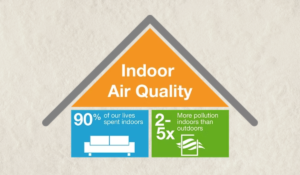
Studies indicate that people spend approximately 90% of their time indoors—in offices, hospitals, schools, shopping malls, factories, and residential buildings. As a result, indoor air quality has a direct impact on occupant health, comfort, productivity, and overall building performance.
What is indoor air quality (IAQ)?
Indoor Air Quality (IAQ) refers to the quality of the air within buildings and enclosed spaces where people live, work, or spend time. It reflects the concentration of airborne pollutants as well as environmental conditions that influence occupant health and comfort.
Good IAQ is achieved when indoor environments provide:
- Safe carbon dioxide (CO₂) concentrations
- Controlled PM2.5 and other airborne particulate levels
- Low concentrations of volatile organic compounds (VOCs)
- Appropriate temperature and relative humidity
- Adequate outdoor air ventilation
In Vietnam, these requirements are specified in TCVN 13521:2022 for residential and public buildings. Internationally, IAQ is also addressed by standards and guidelines such as WHO, ASHRAE, and green building certification systems including LEED and WELL, all of which incorporate indoor air quality performance criteria.
How air distribution systems affect indoor air quality
Delivering clean air to every occupied space
After air is filtered and conditioned by the Air Handling Unit (AHU), it is distributed throughout the building via the air duct system.
When the air duct system is properly designed and installed, airflow is evenly distributed according to design requirements, system pressure remains stable, and sufficient outdoor air reaches every occupied space. This ensures consistent indoor air quality, improves occupant comfort, reduces energy consumption, and supports reliable HVAC operation.
Conversely, poorly balanced air distribution may result in inadequate ventilation in certain areas, leading to elevated CO₂ levels, stagnant air zones, and inconsistent indoor environmental conditions.
Preventing contaminants from entering
Leaks in air duct —particularly within return air systems —can create negative pressure that draws air from ceiling voids, service shafts, basements, or other unconditioned spaces. As a result, dust, moisture, microorganisms, and other airborne contaminants may enter the air duct system and be distributed throughout the building, reducing the effectiveness of the HVAC system in maintaining clean indoor air.
Controlling moisture and preventing mold growth
Moisture is one of the primary conditions that promote mold and microbial growth within HVAC systems.
If air duct system is inadequately insulated or improperly installed, condensation may form on duct surfaces or water may accumulate within the system. Combined with dust and organic matter, these damp conditions create an ideal environment for mold growth.
During HVAC operation, mold spores can become airborne and spread throughout occupied spaces, negatively affecting IAQ, generating unpleasant odors, and potentially impacting occupant health. Proper duct insulation, moisture control, and installation practices are therefore essential for maintaining a hygienic air distribution system.
Maintaining design airflow and system pressure
A properly engineered duct system minimizes pressure losses, maintains design airflow, and improves overall energy efficiency.
However, undersized ducts, excessive fittings, abrupt changes in duct geometry, or inefficient layouts increase system resistance and reduce the actual airflow delivered to occupied spaces.
When supply air or outdoor ventilation air falls below design requirements, the HVAC system becomes less effective at diluting and removing indoor pollutants. As a result, CO₂ concentrations—an indicator of insufficient ventilation—along with particulate matter (PM), volatile organic compounds (VOCs), and other indoor contaminants may accumulate, leading to poorer indoor air quality while increasing fan energy consumption.
Supporting effective air filtration
Air filters within an AHU achieve their intended performance only when the air distribution system maintains its designed airflow path.
If ductwork contains leakage or unsealed joints, unfiltered air may bypass the filtration system and enter occupied spaces directly, reducing the overall effectiveness of air cleaning.
This demonstrates that indoor air quality depends not only on filter efficiency but also on the airtightness, integrity, and quality of the entire air distribution system.
Optimizing air duct systems for better IAQ
Maintaining high indoor air quality requires more than selecting high-efficiency filters. The air duct system itself must be properly designed, manufactured, installed, and maintained throughout its service life.
Key engineering considerations include:
- System airtightness to minimize air leakage, maintain pressure balance, and prevent contaminant infiltration.
- Appropriate duct materials that are durable, easy to clean, and suitable for the building’s operating environment.
- Proper airflow design, including duct sizing, air velocity, and pressure loss calculations to ensure balanced air distribution.
- Effective thermal insulation to prevent condensation and reduce the risk of microbial growth.
- Routine inspection and maintenance to sustain long-term system performance.
An air duct system is far more than a pathway for transporting conditioned air from the AHU to occupied spaces. It is a critical component that helps preserve airflow, pressure, cleanliness, and energy efficiency throughout the HVAC system. By maintaining airtightness, delivering the required ventilation airflow, and minimizing contamination during air distribution, a well-engineered duct system plays a fundamental role in supporting healthy indoor environments.
For buildings with stringent IAQ requirements—including hospitals, data centers, electronics manufacturing facilities, airports, laboratories, and commercial office buildings—selecting an air duct system that is properly designed, manufactured, and installed provides the foundation for reliable HVAC performance, improved energy efficiency, and long-term indoor environmental quality.